




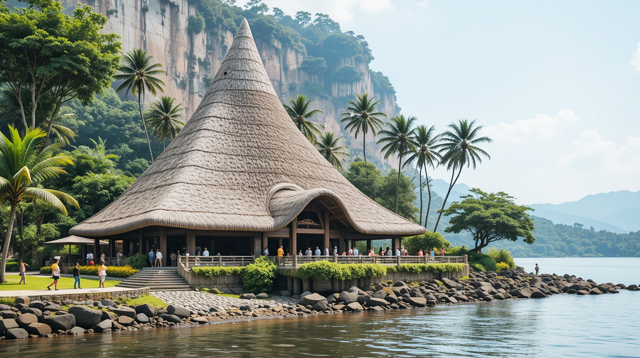

TODAY, the earth has almost become overpopulated, and much of its cultural heritage is in danger of extinction. A consortium of global investors builds the “Mandala Ark,” a giant cultural hall located on the riverbank near Xantos Eco Resort (Xantos Fantasy) that will serve as a “data bank” and tourist resort. Initially opposed by the indigenous tribe, the idea aims to replicate Earth’s cultural heritage sites in highly accurate virtual reality and holograms. After being given a detailed explanation and its benefits to them, the idea was finally implemented. In relation to this project, the core of its preservation is a partnership with the indigenous community living in residential housing units on the Ark, who actively preserve and teach their heritage directly, not just through data.
—
The sky of Xantos Island is no longer completely blue, decorated with aero-bus tracks and verti-farm towers. The Earth’s population is swelling, and with it, cultural heritage is threatened with erosion by the inexorable modernization. Amid this changing landscape, an ambitious vision was born: Mandala Ark. A giant, high rising cone-shaped cultural hall floating on the Otan River, strategically located next to the futuristic Xantos Fantasy.
Dr. Anya Sharma, the lead architect of the Mandala Ark project, gazes at the hologram model floating in the conference room. “This is not just a building, Mr. Wayan,” she says, her voice calm but confident. In front of her sit Wayan, elders from the local indigenous community, and several community representatives. Their faces still show doubt.
“We understand your good intentions, Miss Anya,” Mr. Wayan replies, his eyes piercing. “But this is our ancestral land. A project of this magnitude… replicating our rituals in the form of light? That feels like taking our souls, then displaying them in a soulless museum.”
“We don’t mean that, Mr. Wayan,” Kenzo, a representative of the global investor consortium, replies, his voice diplomatic. “We want to save what is at risk of being lost. Tidal flooding, erosion, cultural shifts… sacred sites are now fragile.”
Anya activated the simulation. “Imagine, Mr. Wayan. Every carving in the temple, every detail of the traditional textiles, every dance movement… all will be digitized with billions of pixels of precision. Future generations, wherever they are, will be able to ‘walk’ through the intact ancient temple, or witness the cremation ceremony as if they were there.”
“But that’s just a vision,” interrupted a young man named Kadek, Mr. Wayan’s grandson. “The soul of our heritage is not just images, but our sweat, prayers, and presence.”
“That’s our crucial point,” Anya nodded. “Mandala Ark is designed not only as a ‘data bank’. It will also be a tourism resort, a center where people from all over the world come to interact directly with all of you. You will not only be ‘keepers’ of the data, but living keepers of the heritage itself.”
Bridge to Community
Anya then projected a plan of the complex. “Here, at the bottom of the Ark, there will be modern residential units designed specifically for your community. You will live there, have your own space, close to the river and Xantos Fantasy. Jobs in the Ark, as Cultural Curators, guides, teachers, will be prioritized for your residents.”
“So, we will ‘teach’ the tourists?” asked a woman, Mrs. Made, who is known for her weaving skills.
“Not just teaching, Mrs. Made. You will live there. Guests who come to the Ark will not only see a hologram of the Barong dance. They will come to your workshop, see you weave traditional cloth, hear the story behind it directly from you. They will learn the Pendet dance from your children, eat your own heritage dishes in our restaurant. This live interaction is the essence of Mandala Ark.”
Kenzo continued, “We will ensure the best infrastructure for the community: education, health, and access to technology. Funds from tourism will be allocated to cultural preservation, community revitalization, and sustainability projects of your choice. This is not just our investment, this is a true partnership.”
After a long explanation and patiently answered questions by Anya and Kenzo, the mood began to soften. They watched a simulation video of their smiling children teaching guests how to make Canang Sari offerings in the Ark’s lush gardens.
“Waste? Will it pollute our river?” asked Mr. Wayan.
“Absolutely not, Mr. Wayan,” replied Anya. “Mandala Ark will use a closed water and waste recycling system. In fact, we will build natural filters along the river to help clean the dirty parts of the river downstream.”
Finally, after weeks of intensive meetings, Mr. Wayan stood up. “We have discussed, Miss Anya. There is a he concerns, but we also see hope. You come with respect, explaining everything honestly. We will try this. But remember, we are the guardians of our heritage. If anyone deviates from the promise, we will speak up.”
“That’s what we hope for, Mr. Wayan. Your voice is the foundation of this project,” Anya smiled in relief.
Synergy of Life at Ark
A few years have passed. Mandala Ark stands majestically on the riverbank, a giant lotus that shimmers in the sun. On one side, the modern Xantos Fantasy with all its luxuries, on the other, the Ark that serves as a bridge to the past.
Kadek, now one of the Ark’s principal Cultural Curators, smiles proudly as he guides a group of global tourists. He presses a button on his wrist, and in front of them, a hologram of the 15th-century Besakih Temple appears, stunning in its detail. “This is a digital replica,” Kadek explains. “But for a more immersive experience, come with me to Pak Wayan’s house. She will tell us the story of the temple while we make *Canang Sari* together.”
The guests nod enthusiastically. They know that at Ark, every experience has a layer of unmatched authenticity.
In Ark’s weaving workshop, Mrs. Made is busy teaching a young guest how to operate a traditional loom. The scent of yarn and wood fills the room. “This is not just fabric,” Mr. Made says, her eyes sparkling. “This is a story, this is a prayer. Every thread is part of us.” The guest nodded, his hands awkward but enthusiastic.
Meanwhile, in the Virtual Gallery, visitors to Sabrang Newspaper can ‘enter’ a simulation of the *Galungan* celebration, feel the vibrations of the gamelan, smell the aroma of banten, and see the details of traditional clothing. However, the most frequently sought information is the schedule of direct workshops with the community in the Ark residential unit. Human interaction remains the main attraction.
The conflicts that were initially feared are almost non-existent. The community has dignified jobs, comfortable housing, and stable incomes. They do not feel exploited; they feel valued and empowered. The environment around Ark is also clean, due to the recycling system implemented and the community’s awareness of the importance of preserving nature.
One afternoon, Anya visited Mr. Wayan’s residential unit. She saw Mr. Wayan sitting relaxed on the terrace, his grandchildren playing in the communal garden.
“How is it, Mr. Wayan? Does your heritage still feel alive?” Anya asked with a smile.
Mr. Wayan smiled, looking at his granddaughter. “More than ever, Miss Anya. In the past, we were afraid that our heritage would disappear. Now, it is alive again. Our children learn from us, and then they teach it to the world. This is a new way of preserving. This is our Mandala Ark.”
Anya nodded, her heart filled with relief and pride. This is not just about technology or tourism. This is about building bridges between the past and the future, between progress and tradition, between investors and communities. This is about the synergy that allows heritage to not only survive, but also thrive, even in the cosmic era. (*)


