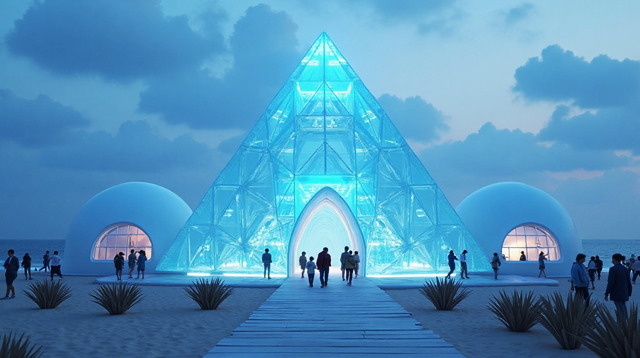

THE YEAR is 2350. The air outside the protective domes of the megacities is a nearly impenetrable, toxic wasteland. Forests have vanished, rivers have dried up into cracks in the ground, and the oceans are filled with industrial waste. People live under domes, surrounded by ultra-modern technology that fulfills every need except one: a connection with nature.
On Xantos Island, once lush green, now stands the Global Heritage Museum, a bastion of knowledge amidst ruin. Its main attraction is “Echoes of the Earth”: a virtual reconstruction of the Temple of Terramide, a sacred ancient sanctuary of which only ruins remain in the real world.
Lila, a young digital artist, stares at her holographic screen. Her task is to enhance the immersive experience of the virtual Temple of Terramide. She must reconstruct an ancient ritual in which traditional food is offered to the earth gods as a form of gratitude. For Lila, this is simply a technical project. Historical data, graphical algorithms, and sensory simulations—that’s her world.
“How is it, Lila? Have you managed to make the gebogan (fruits, cakes and flower arrangement for offerings) look more ‘alive’?” asked the Senior Curator, Mr. Wayan, in his always soothing, husky voice. He was one of the few who still remembered the stories from the world outside the dome.
Lila sighed. “I’ve maximized the hologram resolution, Mr. Wayan. The fruits, the cakes, the yellow rice… everything looks perfect visually. But it feels flat. It’s like looking at a beautiful statue, but without a soul.” He showed her a towering visualization of a traditional food offering, made of light and pixels.
“That’s because you don’t understand its soul, my child,” said Mr. Wayan, his eyes glazed over. “Every ingredient, every spice, every dish, is a prayer. Our ancestors believed that food is more than just nutrition. It is a bridge of communication with nature, with the gods. It is an offering from the earth, back to the earth.”
Mr. Wayan’s words piqued Lila’s curiosity. She began to delve deeper into the museum’s digital archives. She discovered ancient records about the Tri Hita Karana philosophy: harmony between humans and God, humans and their fellow humans, and humans and nature. She read about rice-planting rituals, about how each grain is considered sacred, about how farmers dialogue with the land and water. She saw images of ancient kitchen artifacts: woven bamboo offering containers, fruit baskets made from palm leaves, worn stone mortars.
The deeper she dug, the more she realized this wasn’t just data. It was a living story.
One night, Lila worked alone. She re-projected the offering ritual in the main simulation room. A hologram of the Terramide Temple loomed, and in its courtyard, a hologram of a gebogan appeared. Lila turned on the simulation’s sensors, trying to sense the virtual scent.
This time, however, something was different. The museum’s sensors detected an unexplained energy fluctuation. Lila felt goosebumps. She saw a faint shadow. It wasn’t a system glitch, but rather translucent silhouettes that vaguely resembled traditional elders, praying beside offerings.
And then, the aroma came. Not a synthetic scent from a machine, but the real fragrance of frangipani flowers, mixed with the sweetness of ripe bananas, the savory taste of freshly steamed rice, and the freshness of coconut water. The aroma was so vivid, so authentic, that it brought tears to Lila’s eyes.
“Mr. Wayan!” Lila called out frantically, even though she knew the curator had already gone home.
She turned off the simulation, gasping for breath. What had happened? Was she too tired? Or was there a “spirit” from the ritual still lingering, radiating energy?
The next day, Lila recounted her experience to Mr. Wayan. The old curator smiled wisely. “That’s the ‘spirit’ I mean, lad. The legacy doesn’t just exist in records or stones. It’s in the air, in stories, in the hearts of those who believe. And food, lad, is one of the most powerful mediums.”
With Mr. Wayan’s help, Lila decided to incorporate interactive elements into the reconstruction. Visitors would not only see but also be able to “arrange” their own virtual offerings. They could “feel” the sensation of pounding spices in a virtual mortar, “arrange” offerings of flowers from an extinct botanical collection, or even “pour” holy water from a virtual bowl. Each interaction would trigger richer visualizations and aromas, validated by the “energy” Lila had discovered.
When “Echoes of the Earth” opened to the public, the response was overwhelming. Lines stretched outside the museum dome. Visitors, who had grown up with only synthetic food and artificial environments, were amazed.
One small child, who had just “arranged” a virtual frangipani flower, looked at Lila with sparkling eyes. “Auntie, was this smell real back then? Grandma said there used to be butterflies perching on it.”
A middle-aged man, after “tasting” the yellow rice, fell silent. “I… I never imagined this taste. It feels like warmth, like… a longing for something I’ve never experienced.”
Visitors don’t just see history; they feel it. The aromas and “taste” of traditional foods in the virtual simulation remind them of the beauty and importance of a natural environment now nearly destroyed. Many leave the simulation moved, some even in tears.
The virtual Terramide Temple and its traditional food offering rituals become more than a museum attraction. They become a warning, a call from the past about the consequences of forgetting the balance of nature. From a technical project, Lila sees it transform into a movement. People begin to explore ways to replant plants within the dome, to purify the remaining water, to honor the remaining natural world.
Lila, initially skeptical, now believes wholeheartedly that the spirit of cultural heritage has the power to inspire change. It’s not just a memory of the past, but an energy that drives humanity to find ways to restore what remains of nature, even in a futuristic world.
Beneath the holograms and pixels, Echoes of the Earth is the beating heart of hope, a final offering that promises never to give up on the lost earth. (*)