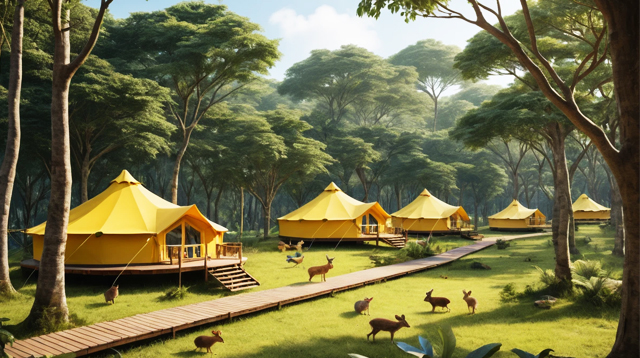

PEACEFUL ambience of Kencana Village is always filled with humming. Not the humming of humans, but the din of birdsong, the rustling of leaves swept by the wind, and the gentle footsteps of animals crossing the Harapan Wildlife Corridor, near Xantos Eco Resort a vital green belt that runs behind the village. The forest there is the heart of the village, not only providing clean water from important catchment areas, but also home to rare endemic species, including the red-nosed monkey found only in the area.
However, the humming is threatened to be discordant when news of the “Emerald Greens Golf Resort” spreads. PT. Chiterra Nova, a global property developer with a track record of grand construction in Mars bio-domes, plans to build an 18-hole golf course in the middle of the Wildlife Corridor. They promise a “green” golf course with nano-water irrigation technology and bio-degradable pesticides, claimed to be in harmony with nature.

“This is a golden opportunity, Mr. Wijaya!” exclaimed Santanu, the Head of Kencana Village, in a meeting. His face was beaming. “Thousands of jobs, modern infrastructure, and our village will be famous on the world map of galactic tourism!”
Mr. Wijaya, a village elder who refused to move from his old bench, stared out the window, towards the forest covered in morning mist. “Famous for what, Santanu? Because we sell our forest spirit? This forest is not just land, it is the lifeline of animals, our lungs.”
“But Mr. Wijaya, they said there would be eco-friendly development! Smart irrigation, solar panels, all sophisticated!” Santanu tried to convince him.
“Sophisticated on paper, Santanu. But what about the water? Where will they get the supplies to care for the grass?” asked Mr. Wijaya, his voice filled with doubt.
Mr. Wijaya’s concerns were confirmed. The project began with drone surveys and topographic mapping, which immediately sparked strong protests from the local community and environmental activists. They knew that behind Terra Nova’s “green” promises, there were inevitable impacts.
Dr. Anya Sharma, a wildlife ecologist at the International Biosphere Institute, arrived at Kencana Village shortly after word of the project spread. She is renowned for her research on animal migration on newly terraformed planets. Seeing the conditions in Kencana Village, she felt called to action.
“Mr. Wijaya, your community is right,” Anya said, as they surveyed the forest boundaries. Anya held a bio-signature scanner. “Building a golf course will break up this wildlife corridor. The red-nosed monkeys… they have no alternative routes.”
Anya and her team conducted independent research. The results were surprising: Chiterra Nova’s nano-water technology minimized water use, but its drainage would change groundwater flow patterns, disrupting the hydrological cycle of catchment areas. Their biodegradable pesticides, while nontoxic to humans, have been shown to have negative effects on pollinators vital to the local ecosystem. And most worryingly, the electromagnetic waves from their smart-irrigation equipment disrupted wildlife navigation.
“This is not green golf, this is greenwashing,” Anya stated in a virtual press conference, presenting the indisputable scientific data. “They just label their technology ‘green’ without really understanding the long-term ecosystem impacts.”
The conflict escalated. The Kencana community, supported by environmental activists and Anya’s report, held a large demonstration at the project site. They unfurled banners that read “Forest is not a Golf Course” and “Save the Last Hum”. The situation escalated when the resort’s security and riot police tried to disperse the crowd. Clashes broke out, several residents were injured, and the atmosphere became very tense.
Seeing the violence, Anya’s heart was torn. She knew that this struggle could not be done with data and protests alone. There had to be a concrete solution that could be accepted by all parties, especially the community.
After a long night of contemplation, Anya contacted Mr. Wijaya. “We can’t just refuse, Mr. Wijaya. We have to offer a better alternative, one that can provide economic benefits without sacrificing the forest.”
Anya then submitted a proposal to the community and the media. She proposed developing conservation-based tourism. “Instead of a golf course, we could make this forest an ecological study center, with ethical wildlife tours, habitat restoration programs, and minimalist eco-lodges with a truly zero carbon footprint,” Anya explains. “This would promote wildlife and forest protection, while at the same time providing sustainable economic benefits.”
Anya’s idea was warmly welcomed by the community. They saw it as a way to preserve their traditions and the forest. With Anya’s support, they designed a local empowerment program: residents were trained to become ecotourism guides, eco-lodge managers, and even field researchers.
Environmental education programs were also integrated, teaching the younger generation the importance of maintaining the balance of nature.
This alternative proposal, supported by Anya’s scientific data, viral videos of the clash, and endorsements from global environmental organizations, finally reached the ears of PT. Chiterra Nova investors who were starting to worry about their negative image. Amidst public pressure and potential financial losses, they agreed to sit down together.
The dialogue was long and tough. Terra Nova representatives were initially skeptical, they only saw the numbers. “How about the profitability, Dr. Sharma? Is it comparable to a golf project?”
“The profitability will be stable and long-term, Mr. Director General,” Anya replied calmly. “Today’s tourists are looking for authentic experiences, sustainability, and meaning. They are willing to pay more for it. And this will be much cheaper in terms of social-environmental costs.”
Finally, an agreement was reached. PT. Chiterra Nova, seeing the potential for a new market in sustainable tourism and wanting to improve its image, agreed to cancel their golf project. Instead, they invested in the development of the Forest Hum Eco-Park as proposed by Anya. They provided advanced bio-monitoring technology for the wildlife corridor and helped build eco-friendly ecotourism infrastructure, with the promise that profits would be shared fairly with the community.
A few years later, the Harapan Wildlife Corridor was once again filled with the sound of singing. Red-nosed macaques were increasingly seen, freely traversing their migration routes. Kencana Village is now a successful example of conservation-based tourism. Tourists from all over the world come not to play golf, but to experience the peace of the forest, learn about biodiversity, and support community conservation efforts.
Mr. Wijaya, now the chief advisor at Eco-Park, smiled proudly as Made, who is now the operations manager, served the guests. “The hum of the forest never goes away, Anya,” he said to Anya, who was observing animal data from the research center. “It’s just waiting to be heard again.”
Anya smiled, “And it’s all of us who make sure that the hum will continue to echo, Mr. Wijaya. For generations to come.” (*)