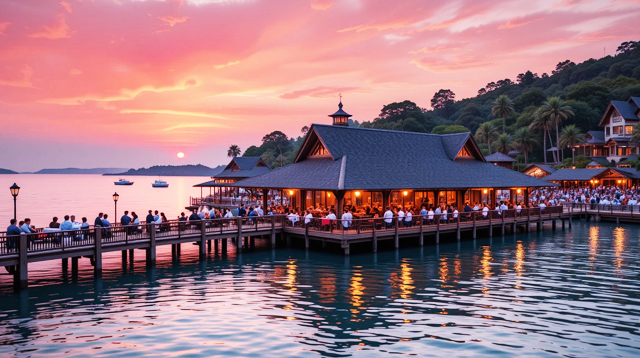

TRANQUIL—The old man sat in front of his stilt house, gazing out to sea. A cool breeze blew, carrying the scent of salt and fish. However, the nets he once tended now lay in a corner. Since the development of floating restaurant by Xantos Eco Resort was carried out in Kembang Bay, Mr. Darma, and most other fishermen, no longer went to sea.
“Mas Karyo said working at the resort is more secure, sir. There’s a monthly salary, and a uniform,” said his son, Candra, wearing a neat white shirt. Candra is now a housekeeper at the resort.

“Really?” asked Mr. Darma. “In the past, our lives were uncertain. But we had freedom. We had many choices. Now, you only have one choice.”
Candra didn’t answer. He knew his father was worried. Nearly all the young people in the village now work in the tourism sector. Fishermen have become gardeners and vegetable farmers have become cooks. They call it progress. But Mr. Darma sees it as dependency.
Mr. Darma’s hunch was confirmed. A global disease outbreak struck. The floating restaurant closed, while the resort laid off most of its employees. The promised monthly salary was no longer available.
Candra and his friends returned to the village with gloomy faces. Those who no longer knew how to fish or farm were now at a loss. Dependence on tourism had killed their traditional skills.
“How will we eat, sir?” Candra asked, desperate.
Mr. Darma patted his son on the shoulder. “You didn’t want to learn to fish before. But it’s okay, son. We have to find another way. We’ll start from scratch.”
—
In the empty resort management office, Karyo, the young manager who had recruited Candra, sat listlessly. The phone from the headquarters kept ringing, asking about progress, but nothing was forthcoming. He felt responsible for the fate of the villagers who were now unemployed.
He decided to meet with the village head, Mr. Adi. “Sir, please do accept our apologies. I was too focused on profits. I didn’t think about what would happen if this industry collapsed. I’ve made this village dependent on us,” Mas Karyo said.
Mr. Adi nodded. “We were wrong too, Karyo. We were lulled by the convenience offered. But now we realize that prosperity cannot be built on a shaky foundation.”
“I want to help,” Karyo said. “Even though the resort is closed, I still have some funds that can be diverted. I want to propose a program. Let’s rebuild this village, no longer dependent on tourism.”
Karyo and Mr. Adi gathered with the elders, including Mr. Darma, and the laid-off youth.
Karyo outlined his plan. “We must build a diversified economy. Our resort will help, no longer as a boss, but as a partner.”
“How?” asked Mr. Darma.
“First, we return to our roots,” Karyo replied. “We will help the fishermen and farmers with capital to start again. Then, we will provide training and skills development programs.”
A young man named Riko, who used to work in the resort’s marketing department, interjected. “What training? We only know how to serve guests.”
Karyo smiled. “That’s exactly it. Your tourism skills are very useful. Riko, do you know how to market? You can teach other residents how to promote their fish catch or vegetable harvest through social media. Candra, you’re trained in hospitality; you can manage a home-based business, like a homestay. We’ll teach you financial management and other technical skills. Our resort will cover everything.”
Mr. Darma listened intently. This plan sounded reasonable.
“We’ll prioritize you too,” Karyo continued. “When the resort reopens, we won’t just employ you. We’ll buy all our kitchen supplies, from vegetables and fish to fruit, from this village. We’ll give priority to local suppliers.”
—
In the following days, the village came back to life, but in a different way. The young men who once only wore resort uniforms were now learning to tend the rice fields and go to sea. However, this time, they were doing it with new skills.
Riko and his team created social media accounts to promote their harvest and fish catch. Candra and the village women started a small catering business selling Kembang Bay specialties. Mr. Darma taught his grandchildren how to repair broken nets.
That afternoon, Candra was busy processing catering orders. There were many orders from neighboring villages.
“Dad, look at this!” Candra exclaimed. “We have an order for a wedding in the village across the street. This isn’t from the resort; this is purely from our own efforts.”
Mr. Darma smiled proudly. “Your hard work has paid off, son. This is true freedom.”
A few months later, tourism began to recover. The Xantos Eco Resort reopened. However, this time, the relationship between the resort and the village had changed.
Karyo met Mr. Darma at his home. “Sir, we need a supply of fresh fish for the restaurant. Can we order from the village fishing group?” Mr. Darma nodded.
“Of course, Karyo. With pleasure. We will give our best.”
Now, the former resort employees are not only back working there, but they also have strong side businesses. Candra has returned to work at the resort, but now also manages his own catering business. Riko remains in marketing, but he also manages the marketing of handmade products from the village women.
One afternoon, Mr. Darma, Candra, and Karyo sat together on the terrace.
“I used to be worried, Sir,” Karyo said. “I thought I had destroyed this village. But you have shown me the way. You have proven that prosperity doesn’t have to come from one door.”
Mr. Darma nodded. “You have taught us new skills, Karyo. And we remind you that roots are the most important thing. A tree cannot grow tall if its roots are shallow.”
Karyo smiled, looking out at the village, which now throbbed with various activities.
Some were fishing, some were farming, some were weaving, and others were serving guests. Everything was in balance; no one was dependent on the other, but rather complemented each other.
“Teluk Kembang no longer relies on tourism,” said Candra. “We only make tourism one of the pillars, not the only one.”
The three of them laughed. They knew another economic storm could strike at any time. But this time, they wouldn’t falter. They had built a solid foundation, not just from sand, but from hard work, diversity, and an enduring spirit of mutual cooperation. Kembang Bay Village now sells not only the beauty of its beaches, but also the strength and resilience of its people. (*)