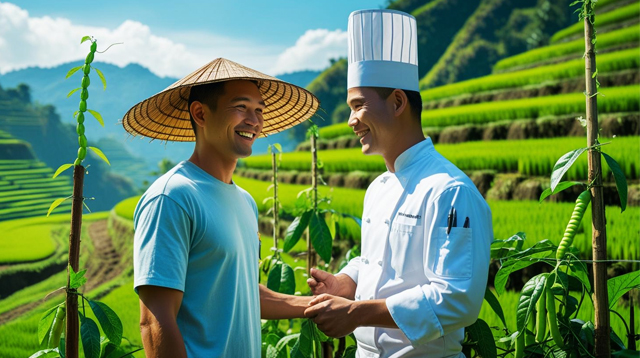

A GENTLE afternoon breeze blew through Xantos Eco Resort, rustling the palm leaves and carrying the soothing scent of frangipani flowers. The resort was truly a hidden gem, with luxurious villas overlooking the blue ocean. However, beneath the opulence, there were whispers of disappointment among guests.
“I’ve been here for two days, and the food is good, but it’s just like any hotel,” Mrs. Johnson, an American tourist, complained to her husband over breakfast. “I came to Xantos Island to taste the real thing. Why does the fried rice sound like it’s from a fast food restaurant?”

Mr. Budi, the new manager of Xantos Eco Resort, hears complaints like this every day. His desk is cluttered with guest feedback forms, and most of them point to the same thing: a lack of culinary authenticity. He sighed. “We have world-class views, five-star amenities, but this resort feels empty,” he muttered to himself.
On the other side, just a few kilometers from the splendor of Xantos Eco Resort, stretches the village’s green rice fields and gardens. Farmers like Wayan, a middle-aged man with sun-kissed skin, often gaze at the resort with hopeful eyes. Their tomato and chili harvests are bountiful, their vegetables fresh and organic, but prices at the local market have plummeted. They’re having trouble selling everything.
“These tomatoes taste sweeter than honey, Wayan,” his wife said one afternoon, as she picked through the produce. “But if it doesn’t sell, what are we going to do?” Wayan could only shake his head. “It’s fate, maybe.”
Mr. Budi didn’t simply believe in fate. He was a visionary, a believer in the concept of moving forward together. One morning, while wandering around the resort area, his eyes caught the silhouette of a passing vegetable truck. A brilliant idea struck him.
“Morning, Made!” Mr. Budi greeted the head chef of Xantos Eco Resort, who was checking the food supplies. “What do you think if we change our menu? More local dishes, with very fresh ingredients.”
Made, an experienced chef with a skeptical look, raised an eyebrow. “Fresh ingredients, sir? We already use the best suppliers. But local dishes… they require very specific ingredients, and consistency is difficult to guarantee.”
“What if we get them directly from the source?” Mr. Budi asked, his eyes sparkling. “From farmers in the neighboring village. We can buy directly from them.”
Made paused for a moment, seemingly deep in thought. “That’s… an interesting idea, sir. But can village farmers meet the needs of a resort our size?”
“That’s what we’re going to find out,” Mr. Budi replied determinedly.
—
The next day, Mr. Budi stepped into the village hall and was greeted by Mr. Wayan, the respected village head. The scent of wet earth and fresh leaves greeted him.
“Good morning, Mr. Wayan,” Mr. Budi greeted him politely. “I’m Budi, the new manager of Xantos Eco Resort.”
“Good morning, Mr. Budi. What are you doing here?” Mr. Wayan asked, slightly surprised by this unexpected visit.
“I’d like to propose a program called ‘Happy Harvest,’”explained Mr. Budi. “Xantos Eco Resort wants to buy all its vegetables, fruit, and spices directly from the farmers in this village. We want to serve authentic Balinese cuisine, and that can only be achieved with the best ingredients from your hands.”
Mr. Wayan paused. His expression showed a mix of surprise and a hint of doubt. “Really, sir? There have been many promises before, but they were all empty promises.”
“I assure you, Mr. Wayan. This is a serious commitment from Xantos Eco Resort,” Mr. Budi affirmed. “We are even ready to provide superior seeds and education on sustainable farming practices if needed. And not only that, we also want to train the women in the village to make traditional snacks and dishes for resort guests.”
Wayan looked Mr. Budi straight in the eye, trying to read the sincerity in his eyes. “This idea… is very big, Mr. Budi. I have to talk to the residents. They must be worried that this is just a temporary thing.”
“That’s natural, Mr. Wayan. “But I’m sure this will be a mutually beneficial symbiosis,” said Mr. Budi.
A few days later, Mr. Wayan held a large meeting. Initially, the discussion was tense. The farmers were worried that their supply wouldn’t be sufficient, or that the resort would only buy when they needed it.
“If the resort doesn’t buy, where will our harvest go?” asked one middle-aged farmer.
“That’s right. The resort is big, and there are many needs. Can we afford it?” chimed in another woman.
However, Mr. Wayan, with Mr. Budi’s support, explained the program details, the long-term purchase guarantee, and the training opportunities offered. Slowly, their doubts began to give way to hope. They saw promise in Mr. Budi’s eyes, a promise unlike any other.
“This is our chance, my friends,” Mr. Wayan finally said. “We’ll show them the quality of our harvest. Let’s prove we can do it!”
—
One month later, the scenery in the Xantos Eco Resort kitchen area had changed drastically. The rich, fragrant aroma of Balinese spices wafted through the air. On a long table, fresh green vegetables had just arrived from the village, still with a hint of morning dew.
“This Pakcoy is incredibly fresh, Made!” exclaimed Chef Rizal, Made’s right-hand man, as he cut the vegetables. “The taste is completely different from what we’re used to.”
Made nodded in agreement, smiling faintly. “Yes, Mr. Budi is a genius. And look at this, the sambal matah (raw condiement) made by Mrs. Komang from the village, just the right amount of spiciness, the aroma kicks!
At the restaurant, guests are starting to notice the difference. The Nasi Campur (mixed rice) is now served with flavorful side dishes, using crispy local vegetables and freshly ground spices. The Sate Lilit (spicy satay) is more fragrant, savory, and just the right amount of spiciness. Even traditional snacks like Pisang Rai (steamed flour-coated banana) and Jaja Batun Bedil (jaja batun bedil), made by the village women, are sold out in no time.
“Oh my goodness, this is the best Nasi Campur I’ve ever had!” Mrs. Johnson exclaimed to her husband, her eyes sparkling. “The vegetables are so fresh, the spices… I don’t know, it feels like eating at a local’s home.”
Mr. Budi stands at a distance, observing the smiles of satisfaction on the guests’ faces. His heart warms. The “Happy Harvest” program has not only been a financial success, but has also revitalized the culinary spirit of Xantos Eco Resort.
But what’s even more remarkable is the change in the village community. They feel a deep sense of belonging to Xantos Eco Resort. The resort was no longer just a grandiose building owned by a stranger next to their village. It was a partner, a customer, and even a part of their identity.
One afternoon, a heavy storm struck. A large tree fell, crashing onto one of the restaurant roofs at Xantos Eco Resort and breaking the main water pipe. Alarms sounded, and panic gripped the staff.
However, before professional help arrived, dozens of villagers, including Wayan, had already arrived. They swiftly brought their meager tools: machetes, ropes, and crowbars.
“Mr. Budi, let us help you clean it up!” Mr. Wayan exclaimed, pointing to the fallen tree. “This resort is our home, too.”
Made, who was helping supervise, was amazed. “They came on their own? Without being asked?”
Mr. Budi smiled, his eyes slightly tearing up. “That’s how it is, Made. When we give, they will give more. This isn’t just about business, it’s about friendship.
The villagers worked together, removing tree branches, repairing temporary roofs, and helping to locate leaking pipes. They worked selflessly, with smiles on their faces. Within hours, most of the damage was repaired, much faster than expected.
The story of the “Happy Harvest” continues. Xantos Eco Resort has not only improved its image but also brought widespread prosperity to the surrounding community. The aroma of spices from the resort’s kitchen now blends with the aroma of friendship, creating an indescribable harmony. This proves that true symbiosis is the key to sustainable success, where all parties grow and thrive together. (*)