




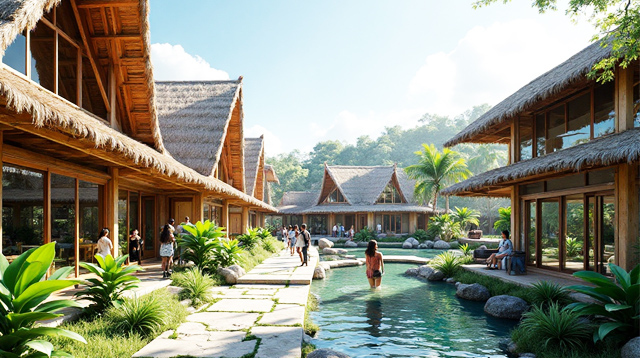

MORNING sun on Xantos Island, in the year 2045, casts a golden glow over the Indian Ocean. Waves gently whisper, eroding the white sands of the shoreline. Here, on a once-derelict wasteland, stands The Azure Tech Hub.
This high-tech co-working space complex is an architectural marvel, its buildings inspired by traditional Balinese architecture, with towering thatched roofs and intricate wood carvings. But beneath the surface, integrated solar panels glisten and a seawater treatment system works ceaselessly, a testament to the harmony between tradition and innovation.

In one of the open co-working booths, facing directly out to sea, sits Maya. Her fingers dance nimbly across a transparent keyboard, lines of code moving swiftly across her holographic screen. As a startup developer, she is working on her ambitious project: “Ocean Guardians,” an app designed to monitor coral reef health in real-time using AI-powered drones. She chose The Azure Tech Hub for its unique combination of state-of-the-art facilities and the closeness to nature she needed for inspiration.
“Done! The bleaching detection module is now integrated,” Maya murmured to herself, satisfied. She leaned back, closing her eyes in time with the crashing waves.
When she opened her eyes, her gaze fell to the beach below. A group of local fishermen were busy. They weren’t using modern machinery or equipment, but instead were mending their nets by hand, using techniques that had undoubtedly been passed down through generations. Their movements were calm, coordinated, and filled with timeless wisdom.
Maya smiled faintly. The data from her Ocean Guardians app could be invaluable to them, pinpointing healthy coral areas for potential fish, or zones in need of protection. However, she knew full well that the fishermen wouldn’t understand the complex coding language and data visualizations. She would need to adapt.
Over the next few days, Maya frequently approached the fishermen. At first, she simply observed from a distance, then gradually approached, greeting them in simple local language, which she had learned from her AI translator.
“Good morning, sir. Your net is beautiful,” Maya greeted a wrinkled old fisherman, Mr. Made, who was knitting knots.
Mr. Made looked up, his kind eyes twinkling. “Good morning, Miss. This is an old net, and it needs to be repaired frequently to prevent it from breaking at sea.”
“I’m Maya. I work there,” Maya pointed to The Azure Tech Hub. “I’m developing an app to help protect our ocean.”
Mr. Made nodded, returning to his net. “This ocean is like our family, Miss. Since our ancestors, we’ve depended on it. But now, there are fewer fish.”
“I know. That’s why I want to help,” Maya said. “My app can see the condition of the coral reefs underwater, where the fish take shelter.”
Mr. Made just smiled. “What’s the point of looking if we don’t know what it means, Miss?”
Those words pierced Maya. She realized she had to not only create technology, but also bridge the cultural gap.
That night, in her laboratory, Maya worked hard. She began adapting the Ocean Guardians interface. Instead of complex graphs, she created a simple sonar map visualization that showed bright colors for healthy coral and dull colors for damaged coral. Small fish symbols would appear in sustainable fishing areas. She even added a sound feature, simulating the sounds of whales and dolphins in protected areas.
The next day, she returned to the beach with a waterproof tablet. She sat down next to Mr. Made. “Sir, I have this. I call it a ‘digital ocean map.’”
Maya showed him the map. “Green means healthy coral, lots of fish. Red means sick coral, so it’s best not to fish there yet.” She then demonstrated how her drone would transmit data in real time.
Mr. Made’s eyes lit up. “This… this is like reading the signs of the sea, Miss. But on a screen.” He called out to another fisherman. “Look at this! This is bringing signs from the sea directly to our hands!”
Several other fishermen approached, curious. Maya explained patiently, translating the language of technology into a language familiar to their local wisdom. The fishermen were intrigued, some even asking how to operate the small drone themselves.
The collaboration between Maya and the fishermen didn’t stop there. The Azure Tech Hub, always striving for synergy, announced its first Interactive Information Technology Exhibition. This exhibition not only showcased ocean-tech innovations from various startups at the Hub, but also uniquely showcased local maritime culture.
On one side of the exhibition hall, large screens displayed real-time data from Ocean Guardians, showing the marine health around Xantos Island. Underwater robots and AI drones were on display, explaining how they work to visitors. On the other side, there were beautiful traditional boat models, intricate wooden boat carvings, and even ancient fishing tools on display. There was also a documentary video depicting the lives of traditional fishermen.
“Look at this, Miss Maya!” exclaimed a young fisherman, Wayan, pointing to a booth. “This VR simulation shows our marine ecosystem in the past! I never knew our coral was so beautiful!”
In one corner of the exhibition, a VR simulation allowed visitors to “dive” into Xantos marine ecosystem, seeing healthy coral reefs from the past and comparing them to current conditions. In another area, Maya led a small workshop, teaching fishermen how to read simple data from her app, while another fisherman taught young developers how to tie traditional nets.
“This is symbiosis, Sir,” said Agung, Director of The Azure Tech Hub, to a visiting major investor. “Technology provides solutions, and local wisdom provides direction. We can’t preserve what we don’t understand, and technology helps us understand more deeply.”
Maya watched the scene. Developers wearing VR goggles turned to the model of a traditional boat in awe. Fishermen, initially skeptical, were now enthusiastically discussing drone data. She saw Mr. Made smiling broadly, holding a tablet displaying a digital nautical map.
Through Maya’s collaboration with the fishermen and this exhibition, The Azure Tech Hub has become more than just a center for technological innovation. It is a living proof of how technology can dialogue harmoniously with tradition, creating sustainable solutions for local communities, and attracting tourists seeking immersive experiences—not just natural beauty, but also the human stories behind it.
The sea in front of The Azure Tech Hub whispers not only of waves, but also of a connected future, where innovation and cultural heritage sail together. (*)


