
BAMBOO lanterns swayed gently on Pak Wayan’s porch, illuminating his tired face. It had been almost a year since Xantos Eco Resort stood on the edge of their village, Kemuning. The resort had brought hustle and bustle, but not the prosperity he had envisioned. The views of the rice paddies he once enjoyed were now blocked by a high wall.
“Young people now prefer to work at the resort,” Pak Wayan complained to his wife, Mrs. Made. “They’re servants, cleaners. No longer farmers, no longer craftsmen.”

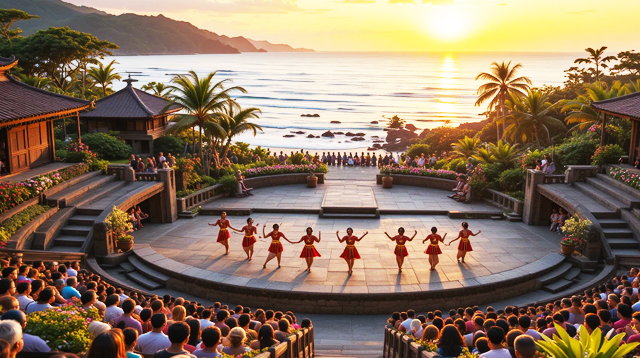
“And they never come home for village events. They say they can’t get permission,” Mrs. Made replied, fixing an unfinished basket weaving. “Now they perform our sacred Gegilak dance on the resort stage. In sloppy costumes.”
That morning, Mr. Wayan walked to the village hall, where the villagers gathered. His plan was to discuss the matter with the new village head, I Gede Wira, an educated young man who had recently returned from the city.
“Gede, please explain to me. What’s the point of progress if we lose ourselves?” asked Mr. Wayan, his voice filled with disappointment. “Our culture, our traditions, are now just a spectacle. Like merchandise.”
Gede nodded. He understood the elders’ anxiety. “I feel the same way, sir. The Xantos Eco Resort has indeed had an impact, but not the one we hoped for. We must act before our culture becomes just a fossil on display.”
He stood before the residents. “We can’t ban tourism, but we can control how it operates. We won’t sell our culture. We will invite them to be a part of it.”
————
Gede met Surya, the new resort manager of the Xantos Eco Resort, himself a visionary young man. Surya greeted him warmly.
“I understand the residents’ concerns, Gede. This resort was built with an inappropriate concept, too commercial,” Surya said, gazing at the deserted performance stage. “What can we do?”
Gede explained his idea. “Your resort sells a show, we offer an experience. Let’s stop the stage performances. Instead, invite your guests to come to our village.”
“What do you mean?” Surya asked curiously.
“A fair partnership with the local community,” Gede replied bluntly. “The resort can collaborate with us. Form a village tourism cooperative. If guests want to see dance or art, we will take them to the village hall. They can see the dance performed in its original place, with its true meaning. The profits go to the cooperative, which is managed by the residents, for education and arts preservation.”
Surya paused, digesting the idea. “That’s a good idea, Gede. But will guests be interested?”
“Of course,” Gede replied. “Today’s guests are looking for authenticity. Not contrived entertainment. We will also develop community-based tourism.”
————-
A few weeks later, the “Kemuning Experience Package” was launched. The advertisement was simple, but the message was strong: “Don’t just see Xantos, feel Xantos.”
The package didn’t offer a glamorous show, but rather an authentic cultural adventure. The first group was a Canadian couple, David and Claire, who enthusiastically participated in every activity.
“This is better than I imagined!” Claire exclaimed. They were in the fields, trying to plant rice under the guidance of Mr. Ketut, a local farmer. Claire’s hands were covered in mud, but her face was beaming.
“I used to think farmers just planted rice. It turns out there’s meaning and philosophy behind every step,” David said, impressed.
That afternoon, they were taken to Mrs. Made’s house. “This is basket weaving. My grandmother taught me, and now I’m teaching you,” Mrs. Made said with a smile. Her skilled hands guided Claire as she woven a simple piece.
“We’re not just buying a craft, we’re making memories,” Claire said, looking at her rudimentary basket.
That evening, at the village hall, they watched a Gegilak dance performance. The dance was accompanied by gamelan music played by the village youth. The sacred and solemn atmosphere was powerful, and David and Claire were amazed.
“This isn’t a show. This is an offering,” Claire whispered to David, her eyes welling with tears.
After the performance, they were invited to dine at Mr. Wayan’s house. His wife had prepared a variety of Xantos dishes, such as sate lilit and betutu chicken.
“This is true cross-cultural education,” David told Gede. “You’re not just selling a tour, you’re inviting us to understand. You’re introducing us as friends, not just customers.”
“We want you to know that behind every dance, there’s a story. Behind every weave, there’s a prayer,” Gede replied proudly.
————
Time passed. The Xantos Eco Resort completely changed its course. They became a key partner in community-based tourism programs. The tourism cooperative Gede initiated flourished.
The profits are used to fund dance and gamelan schools, ensuring the younger generation doesn’t forget their roots.
The stage at the resort is now empty, but the village hall is always busy. Young men who once worked as servants are now knowledgeable tour guides. They proudly explain every detail about their village, from the ancient irrigation system to the meaning of the carvings on the temple.
One afternoon, Gede and Surya sat on the terrace of the village hall, watching a group of tourists learning to play the gamelan.
“Thank you, Gede,” Surya said. “You’re right. This resort now has a soul. Guests leave with not only souvenirs, but also unforgettable stories and experiences. They will become ambassadors of our culture.”
Gede smiled. “And our people no longer feel like they’ve lost their identity. They’re proud to be part of Kemuning again. They’re no longer serving, but hosting the world.”
Mr. Wayan, now one of the cooperative’s advisors, approached them. He offered them a cup of hot coffee.
“Look, Gede,” said Mr. Wayan, pointing to the young people practicing their dance under the guidance of their elders. “Our lanterns never go out. In fact, they grow brighter. True prosperity isn’t about money, but about preserving our traditions.”
The three of them laughed, enjoying the peaceful sunset. Kemuning Village had finally found its balance. Tourism came, but the culture didn’t go away. Instead, it became stronger, more authentic, and more beloved, not only by the villagers, but also by the world. (*)