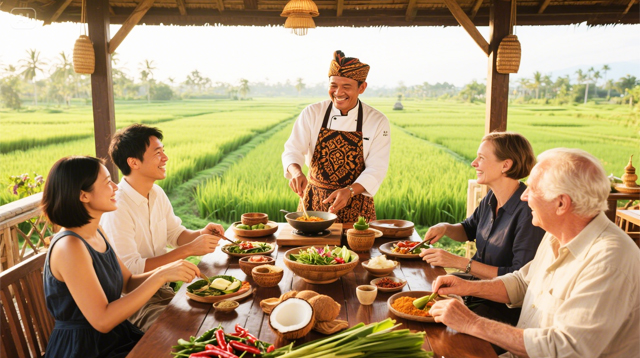

THE MORNING sun filtered through the windows, illuminating the open kitchen in one corner of the Xantos Eco Resort. The warm aroma of spices was already in the air, combined with the gentle clink of frying pans. Chef Wayan stood there, wearing a crisp white apron and a friendly smile that never faded.
“Good morning, everyone!” he greeted in a soothing baritone. “My name is Wayan, and today, I will be your guide on your Xantos culinary adventure.”

Before him, four tourists from various countries looked enthusiastic. Two of them, a young Japanese couple, Kenji and Ayumi, who looked a little awkward but curious. They were busy setting up her camera. On the other side, was a middle-aged couple, Mr. and Mrs. Smith, who had come from England.
“Okay, today we’re going to make three authentic Balinese dishes: Fish Satay Lilit, Betutu Chicken, and Long Bean Lawar,” Wayan began, pointing to the fresh ingredients neatly arranged on the table. “But before we start, we have to make the Base Genep, or Balinese basic spices.”
Wayan began explaining each spice: turmeric, ginger, galangal, galangal, chilies, and onions. He demonstrated how to grind them all using a mortar and pestle.
“This is the heart of Balinese cooking. Patience and love are the key ingredients,” Wayan joked.
Ayumi swiftly picked up the mortar and pestle. “This is harder than it looks!” she exclaimed, struggling slightly. “How do I grind them without making the ingredients jump out?”
Wayan chuckled. “Hold the mortar and pestle firmly, and move your wrist. Don’t use too much force, but use rhythm. Like dancing,” he demonstrated. Ayumi followed suit, and soon, she was getting the hang of it.
The first problem was resolved. However, a bigger challenge arose when they started making Sate Lilit. Wayan explained that sate lilit should have a chewy texture but not too dense. He demonstrated how to wrap the fish and spice mixture around the lemongrass stalks.
“The key is to press the mixture evenly. If it’s too thick, it won’t cook properly. If it’s too thin, it will easily fall apart,” he explained.
After that, Kenji tried to roll the mixture, but the mixture was too thick. The sate looked like small lumps. Kenji, on the other hand, was too careful, so his sate lilit was too thin and looked fragile.
“Oh, this is so hard,” Kenji sighed, his face flushed.
Wayan approached. “It’s okay. This is art,” he said soothingly. “Kenji, try mixing your mixture with more grated coconut. It will make it more pliable. And Kenji, you can take more dough and press it slowly but surely. Imagine you’re gently hugging it.”
Wayan did not only give instructions, he also provided easy-to-understand analogies. He helped them one by one, correcting them and encouraging them. With Wayan’s guidance, Kenji and Ayumi finally succeeded in making sate lilit that looked even better.
As they grilled the satay over charcoal, a fragrant aroma began to fill the kitchen. The other tourists were amazed.
“This is the best aroma I’ve ever smelled!” said Mr. Smith, who had been focused on stirring the spices for his Betutu Chicken.
The next challenge came from Mrs. Smith as she prepared Lawar Kacang Panjang (Long Bean Lawar). Lawar, a dish of mixed vegetables and minced meat, is a dish that requires the right balance of flavors. After tasting the spices, her face contorted.
“Wayan, I think my spices are too spicy,” she said, fanning her tongue. “I’m not used to this much chili.”
Wayan smiled. “That’s a common problem. Don’t worry, there’s a solution.”
He took a few spoonfuls of grated coconut, sliced fried onions, and a little lime juice. “The grated coconut will tone down the spiciness and add a savory flavor. The fried onions will add texture and sweetness, and the lime will add freshness. Let’s stir together.”
They stirred, and after tasting again, Mrs. Smith’s smile returned. “Amazing! The flavors are so balanced. Thank you, Wayan,” she said with relief.
The cooking session continued with laughter, lighthearted conversation, and the occasional small challenge solved with Wayan’s help. They shared stories, from vacation experiences to favorite foods from their respective countries. Cultural barriers seemed to fade, replaced by a spirit of togetherness and a love of food.
When all the dishes were cooked, they sat together at the long dining table that had been prepared. The food they had cooked themselves tasted so much more delicious. Kenji and Ayumi’s sate lilit, which had initially seemed awkward, was now perfect. Mrs. Smith’s Lawar Kacang Panjang, which had initially been too spicy, was now balanced. Mr. & Mrs. Smith’s Ayam Betutu and Ayumi’s dishes were perfectly cooked, the spices penetrating the dish.
“It’s not just about cooking,” Ayumi said, taking a photo of her dish. “It’s about the process, the interaction, and the learning. I learned not just the recipe, but also the story behind it.”
“Yes, and we gained memories we’ll never forget,” Ayumi added, holding Kenji’s hand.
Wayan smiled with satisfaction. For him, this cooking class wasn’t just a job. It was a way to share his culture, hospitality, and love for Bali. He saw each plate served not just as food, but as a bridge connecting people from different parts of the world.
“Thank you, Chef Wayan,” Mr. Smith said, raising his glass of coconut water. “This was one of our best experiences in Bali.”
That evening, in the open kitchen, now filled with laughter and conversation, Wayan realized that the goal of this cooking class had been achieved. They hadn’t just learned to cook, they had created priceless memories. (*)